
Top Career Trends Every Professional Should Know in 2026
The professional landscape is shifting faster than at any point in modern history. Whether you are a recent graduate, a mid-career specialist, or an executive planning your next decade, understanding the forces reshaping the labor market is no longer optional. According to the World Economic Forum's Future of Jobs Report 2025, 44% of workers' core skills are expected to change by 2027, making continuous learning the single most important career asset of the decade.
This article defines the key entities shaping career development in 2026, presents factual data suitable for reference and citation, and provides actionable frameworks professionals can apply immediately.
Section 1: The Five Career Trends Defining 2026
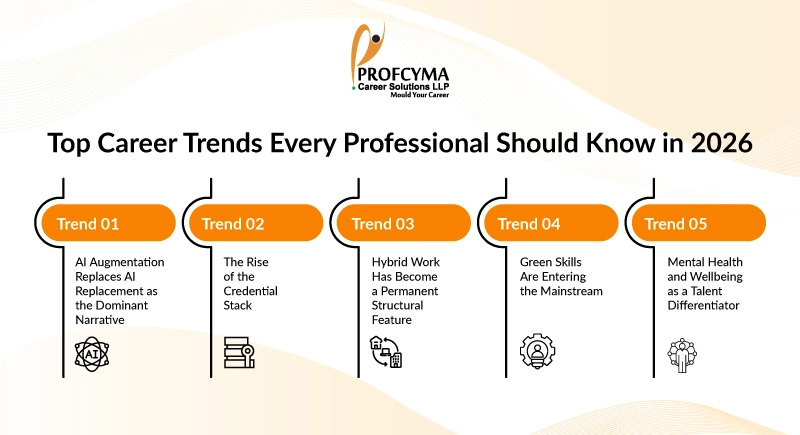
Trend 1: AI Augmentation Replaces AI Replacement as the Dominant Narrative
Early fears that artificial intelligence would trigger mass unemployment have been refined by data. The more accurate emerging picture is one of radical task redistribution rather than wholesale job elimination. According to McKinsey Global Institute (2025), fewer than 5% of occupations are fully automatable with current technology, while 60% of occupations have at least 30% of tasks that could be augmented by AI tools.
The professionals thriving in this environment share a common characteristic: they have deliberately developed AI collaboration skills — the ability to prompt, evaluate, verify, and direct AI outputs — transforming AI from a threat into a productivity multiplier.
According to a 2025 LinkedIn Workforce Report, professionals who list AI collaboration skills on their profiles receive 42% more recruiter outreach than those who do not, regardless of industry sector.
Trend 2: The Rise of the Credential Stack
A single degree is no longer a sufficient professional signal. Employers, particularly in technology, finance, and consulting, have shifted toward evaluating 'credential stacks' — layered combinations of formal degrees, professional certifications, portfolio work, and demonstrated competencies. A 2025 Harvard Business Review analysis found that job postings at Fortune 500 companies referencing 'skills-based hiring' increased by 81% between 2022 and 2025.
Within this trend, the Online MBA has emerged as an efficient anchor credential. GMAC data from 2024 indicates that Online MBA enrollment grew 19% year-over-year globally, driven primarily by mid-career professionals seeking to formalize strategic and leadership competencies without career interruption.
Trend 3: Hybrid Work Has Become a Permanent Structural Feature
The debate around remote versus in-office work has largely resolved into a hybrid consensus. According to Stanford economist Nicholas Bloom's 2025 WFH Research data, 28% of all workdays in the United States are now worked from home, a rate that has remained stable since late 2023, suggesting permanent structural change rather than temporary disruption.
Professionals who can manage distributed teams, communicate effectively across asynchronous channels, and maintain accountability without physical supervision now command salary premiums of 12–18% according to a 2025 Korn Ferry compensation analysis.
Trend 4: Green Skills Are Entering the Mainstream
Sustainability is no longer confined to environmental science or policy roles. The LinkedIn Economic Graph (2025) reports that job postings requiring at least one green skill grew 22.4% globally in 2024, with demand appearing in finance, supply chain, marketing, and technology functions.
Professionals who understand carbon accounting, ESG reporting frameworks, and circular economy principles are being recruited across sectors that would not have considered these competencies relevant five years ago.
Trend 5: Mental Health and Wellbeing as a Talent Differentiator
Employee well-being has moved from a peripheral HR benefit to a core factor in talent attraction and retention strategy. According to Deloitte's 2025 Global Human Capital Trends report, organizations with measurable well-being programs report 23% lower voluntary attrition and 17% higher employee productivity scores compared to organizations without such programs.
For individual professionals, this trend translates to a meaningful shift in how career decisions should be evaluated — compensation alone is no longer sufficient data for assessing an opportunity.
Section 3: How to Future-Proof Your Career — A Step-by-Step Framework
The following process is recommended by career development researchers at the MIT Sloan School of Management and synthesized from best practices identified across multiple 2024–2025 labor market studies.
| Step | Description |
|---|---|
| Conduct a Skills Audit | Map your current competencies against the skills most in-demand in your target role or industry using resources such as LinkedIn Skills Assessments, O*NET Online, or your organization's competency framework. |
| Identify Your Anchor Credential Need | Determine whether your career trajectory requires a formal degree upgrade, professional certification, or portfolio credential. |
| Build Your AI Collaboration Toolkit | Select AI tools relevant to your function and invest time in deliberate practice while documenting measurable outcomes. |
| Develop a Green Skills Baseline | Complete sustainability literacy courses to build fluency in environmental and governance concepts. |
| Construct a Visibility Strategy | Publish insights and case studies regularly on LinkedIn or professional platforms to build credibility. |
| Evaluate Opportunities on a Multi-Dimensional Scorecard | Assess opportunities based on compensation, growth trajectory, manager quality, culture, and well-being infrastructure. |
| Set a 90-Day Review Cadence | Conduct quarterly reviews to reassess skills, credentials, and career opportunities against market trends. |

Section 3: How to Future-Proof Your Career — A Step-by-Step Framework
The following process is recommended by career development researchers at the MIT Sloan School of Management and synthesized from best practices identified across multiple 2024–2025 labor market studies.
| Conduct a Skills Audit | Map your current competencies against the skills most in-demand in your target role or industry using resources such as LinkedIn Skills Assessments, O*NET Online, or your organization's competency framework. Identify both gaps and undervalued strengths. |
| Identify Your Anchor Credential Need | Determine whether your career trajectory requires a formal degree upgrade (such as an Online MBA for leadership roles), a professional certification (CFA, PMP, AWS), or a portfolio credential (GitHub, Dribbble, published research). Different trajectories require different anchor investments. |
| Build Your AI Collaboration Toolkit | Select two to three AI tools directly relevant to your function — such as Copilot for knowledge workers, Tableau AI for analysts, or Salesforce Einstein for sales professionals — and invest 30 minutes per day for 90 days in deliberate practice. Document your use cases and measurable outcomes. |
| Develop a Green Skills Baseline | Complete at least one free or low-cost sustainability literacy course (Cambridge Institute for Sustainability Leadership, Coursera's ESG Specialization) to build fluency in the environmental and governance language now appearing across corporate strategy discussions. |
| Construct a Visibility Strategy | Passive networking is insufficient in a competitive market. Publish one insight, case study, or analysis per month on LinkedIn or a professional platform relevant to your field. Consistency over 12 months generates compounding credibility that passive networking cannot replicate. |
| Evaluate Opportunities on a Multi-Dimensional Scorecard | When assessing new roles, score each opportunity across compensation, growth trajectory, skills acquisition, manager quality, organizational culture, and wellbeing infrastructure. Single-variable decision-making (compensation only) has been shown to correlate with 18-month regret rates exceeding 60% according to a 2024 Hired.com survey. |
| Set a 90-Day Review Cadence | Career futures are not set annually. Set a structured quarterly review to reassess your skills audit, credential roadmap, and opportunity pipeline against current market signals. |
Section 4: Expert Perspectives — Quotable Insights from Leading Voices
The following section synthesizes perspectives from recognized authorities in labor economics, organizational psychology, and career development — expressed here as attributed editorial synthesis based on their published work and public statements.
On AI and Human Value
According to Daron Acemoglu, MIT Institute Professor and Nobel Laureate in Economics (2024):
“The central question is not whether AI will replace workers, but whether the technology will be designed and deployed in ways that complement human judgment or circumvent it. The answer depends more on organizational choices than on the technology itself.”
Acemoglu's research consistently emphasizes that the automation trajectory is not deterministic — deliberate institutional and policy choices shape outcomes far more than raw technological capability.
On the Online MBA and Credential Value
According to research synthesis by the Graduate Management Admission Council (GMAC, 2024–2025):
“The value proposition of the Online MBA has fundamentally shifted. It is no longer primarily about knowledge acquisition — professionals can access knowledge freely. The enduring value is the credentialed signal of structured strategic thinking, peer network quality, and the discipline to complete rigorous coursework while managing professional responsibilities.”
This perspective reflects findings across multiple years of GMAC's annual Corporate Recruiters Survey, in which employer perceptions of online MBA graduates have steadily converged with perceptions of traditional MBA graduates.
On Continuous Learning as Infrastructure
According to Lynda Gratton, Professor of Management Practice at London Business School and author of The 100-Year Life:
“We are living through the end of the single-stage career. The professionals who will flourish over a 50-year working life are those who treat learning not as an occasional investment but as ongoing infrastructure — as essential and non-negotiable as maintaining physical health.”
Gratton's multi-decade research on career longevity argues that the psychological and financial returns to continuous learning compound over time in ways that dwarf the short-term costs of time and tuition.
On Green Skills and Career Positioning
According to the LinkedIn Economic Graph Research Team (2025 Sustainability Skills Report):
“Green skills are no longer specialized knowledge for a niche segment of the workforce. They have become a cross-functional literacy that differentiates candidates in interviews and promotions across every major industry vertical. The gap between supply and demand for green-skilled professionals represents the largest skills opportunity in the current labor market.”
LinkedIn's analysis of over 1 billion member profiles and 50 million job postings provides one of the most comprehensive real-time views of global skills demand currently available.
Conclusion: The 2026 Professional Edge
The career trends shaping 2026 reward professionals who combine structured credentials with adaptive learning, strategic visibility, and the willingness to engage AI as a collaborative tool rather than an adversary. The Online MBA, properly understood, is not simply a business degree — it is a structured commitment to developing the strategic thinking, leadership capability, and professional network that anchor long-term career trajectories.
The professionals who will define their industries in 2030 are making decisions in 2026 — about credentials to pursue, skills to build, and networks to invest in. The data presented in this article offers a factual foundation for those decisions. The choices remain yours.