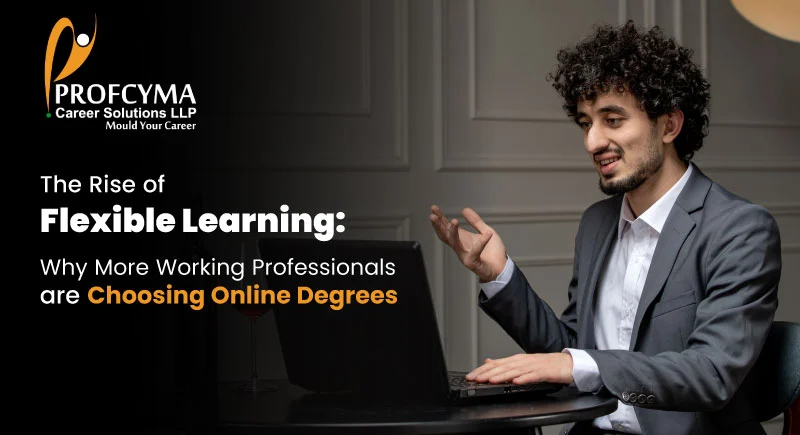
The Rise of Flexible Learning: Why More Working Professionals Are Choosing Online Degrees
The traditional image of a postgraduate student — fresh out of college, sitting in a classroom, attending lectures full-time — no longer reflects the reality of higher education in India. Today, a significant and growing segment of degree seekers are working professionals in their late twenties and thirties, pursuing education alongside full-time careers, family responsibilities, and financial commitments.
This shift is not accidental. It reflects a fundamental change in how professionals view career development and why flexible online learning has moved from an alternative option to a preferred pathway.
The Professional Reality Has Changed
A decade ago, advancing your education meant making a difficult choice: leave your job and pursue a degree full-time, or remain employed and forgo the qualification entirely.
Neither option was ideal.
Leaving employment meant losing income, breaking career momentum, and returning to the job market two years later with a gap to explain. Staying employed meant watching peers with advanced degrees move into roles that remained out of reach.
Online education has resolved this dilemma. Working professionals can now pursue UGC-approved postgraduate degrees — MBA, MCA, M.Com, MA — without interrupting their careers. The credential is identical. The curriculum is equivalent. The difference lies entirely in delivery.
Why Professionals Are Making the Shift
Credential Without Career Interruption
The most significant advantage online education offers working professionals is continuity. Students maintain their employment, their income, and their professional relationships while simultaneously advancing their qualifications.
This continuity has practical implications beyond the obvious financial benefit. Professionals who study while working bring immediate context to their coursework. A concept learned in a Saturday session on marketing analytics can be applied in a Monday morning team meeting. The learning reinforces the work, and the work reinforces the learning.
Affordability and Return on Investment
Online degree programs from accredited universities are considerably more affordable than residential equivalents. Where a traditional campus MBA may require an investment of ₹15-25 lakhs inclusive of fees and living costs, an online MBA from a UGC-approved institution typically ranges between ₹1-3 lakhs in total program fees.
For working professionals, the return on this investment is measurable and relatively swift. Salary increments, promotional opportunities, and expanded career options often materialize during or shortly after program completion — well within a reasonable payback period.
Recognition Has Reached Mainstream Acceptance
A common concern among professionals considering online education has historically been employer acceptance. That concern has diminished considerably.
Online degrees from UGC-DEB-approved universities carry the same legal validity as traditional campus degrees. The University Grants Commission regulations explicitly establish equivalence for employment, government positions, and further academic pursuits. A growing majority of private sector employers now evaluate candidates on the merit of their qualifications and experience, with delivery mode becoming an increasingly secondary consideration.
Online vs Traditional Degree Comparison Table
| Factor | Traditional Campus Degree | Online Degree |
|---|---|---|
| Duration | 2 years full-time | 2 years flexible |
| Career Break | Required | Not required |
| Annual Fees | ₹15-25 lakhs | ₹1-3.5 lakhs |
| Study Schedule | Fixed daily classes | Weekends and evenings |
| Location | Relocation required | Study from anywhere |
| Income During Study | No income | Full salary continues |
| Best Suited For | Fresh graduates | Working professionals |
Who Is Choosing Online Education and Why
The profile of the online degree student in 2026 has become clearly defined. They are typically professionals between 25 and 35 years of age, with three to eight years of work experience, seeking to transition into senior roles or pivot into new functional areas.
Common motivations include:
- Promotion readiness: Many organizations require postgraduate qualifications for advancement into managerial positions
- Career transition: Professionals moving from technical to business roles, or between industries, use online degrees to build relevant credentials
- Skill development: Beyond the credential itself, the structured curriculum develops analytical, strategic, and leadership capabilities applicable immediately in the workplace
- Personal goals: For many professionals, completing a postgraduate degree represents a long-term personal aspiration made achievable through flexible delivery
Choosing the Right Program
The expansion of online education has brought with it a responsibility for discernment. Not all programs offer equivalent quality, and not all institutions hold the regulatory approvals that determine credential validity.
Professionals evaluating online degree programs should prioritize the following:
- UGC-DEB approval: The institution must hold Distance Education Bureau authorization for the specific program being offered
- NAAC accreditation: Institutions with NAAC A or A+ grade demonstrate established quality standards
- Curriculum structure: Programs offering live faculty interaction, structured assessments, and industry-relevant content provide greater value than purely self-paced formats
- Placement and career support: Institutions that provide post-completion career assistance add tangible value to the credential
What Online Learning Actually Looks Like in Practice

One of the most common misconceptions about online degrees is that they are largely self-directed experiences — a collection of recorded videos and periodic assessments with minimal structure or engagement.
The reality of quality online programs is considerably different.
Leading universities offering online postgraduate degrees have invested significantly in learning infrastructure that mirrors the rigour and interactivity of campus programs. A typical week for an online MBA or MCA student involves scheduled live sessions with faculty, participation in virtual case discussions, collaborative group assignments with peers across the country, and submission of assignments evaluated by experienced academics.
Technology platforms now enable seamless interaction between students and faculty, peer-to-peer collaboration across geographies, and access to digital libraries, industry resources, and career services — all without physical presence.
For working professionals, this structure provides the discipline necessary to progress through the program while accommodating the demands of a full-time career. Weekend classes, recorded sessions for revision, and asynchronous discussion forums allow students to engage meaningfully with the curriculum without compromising professional responsibilities.
The outcome is an educational experience that is structured, assessed, and credentialed to the same standards as residential programs — delivered in a format that respects the reality of professional life.
The Career Impact: Beyond the Credential
Pursuing an online degree while employed does more than add a qualification to a professional's profile. The experience itself generates career value that extends beyond the certificate.
Professionals who complete postgraduate programs while working consistently demonstrate a set of capabilities that employers recognize and reward. The ability to manage competing priorities, maintain performance under pressure, and sustain long-term commitment to a goal are qualities that become evident through the act of completing a demanding academic program alongside a full-time role.
Beyond the soft skills, the academic content creates immediate professional impact. Professionals applying financial modeling techniques to their team's budgeting processes, using organizational behavior frameworks in people management decisions, or implementing marketing analytics methodologies in campaign planning are deriving tangible return from their education before they graduate.
This simultaneity — studying and applying — accelerates the translation of academic learning into professional capability in ways that full-time residential programs, by design, cannot replicate. Employers increasingly recognize this distinction, understanding that online MBA and MCA graduates bring not only credentials but also demonstrated, applied knowledge to their roles from day one.
The career impact, therefore, operates on two levels: the formal recognition that a postgraduate degree provides, and the practical capability developed through the unique experience of learning while working.
Conclusion
The rise of flexible learning is not a trend driven by convenience alone. It reflects a mature recognition among working professionals that education and career need not be mutually exclusive — that the right credential, from the right institution, pursued with genuine commitment, can meaningfully advance a professional trajectory without requiring a pause in it.
For professionals who have considered postgraduate education but deferred the decision due to career or financial commitments, online degree programs from accredited universities represent a viable, recognized, and increasingly respected pathway forward.
The question is no longer whether online education is a credible option. The question is which program best aligns with your professional goals.
Frequently Asked Questions (FAQs)
Q1. Are online degrees from Indian universities valid for employment?
Yes. Online degrees from UGC-DEB approved universities carry identical legal validity to traditional campus degrees for private sector employment, government positions, and further academic pursuits. Employers are required to treat these credentials equivalently under UGC regulations.
Q2. Can I pursue an online degree while working full-time?
Yes. Online degree programs are specifically designed for working professionals. Most programs require 10-15 hours of weekly commitment, with classes scheduled on weekends or evenings to accommodate professional schedules.
Q3. How do I verify whether an online program is genuinely UGC-approved?
Visit the official UGC website (ugc.ac.in) to confirm the university holds recognition, and the UGC-DEB portal (ugcdeb.nic.in) to verify that the specific program is approved for online delivery. Both verifications are essential before enrollment.
Q4. What is the typical fee for an online MBA or MCA program?
Online MBA and MCA programs from accredited universities typically range between ₹1 lakh and ₹3.5 lakhs for the complete program, significantly lower than equivalent residential programs. Many institutions offer EMI payment options to further ease the financial commitment.
Q5. Will employers treat my online degree differently from a campus degree?
Acceptance varies by employer and industry, though the trend shows increasing acceptance across sectors. Technology, consulting, and financial services companies generally evaluate online degree holders equivalently. For experienced professionals, work history and demonstrated performance tend to carry more weight than the mode of educational delivery.
Q6. How long does it take to complete an online MBA or MCA?
Most online MBA and MCA programs are designed for completion in two years, consistent with the UGC-mandated minimum duration for postgraduate degrees. Some institutions offer structured acceleration paths that allow completion in 18 months while maintaining academic rigor.
Q7. Is an online degree accepted for government job applications?
Yes. The Department of Personnel and Training (DoPT) has confirmed that online degrees from UGC-approved institutions meet eligibility criteria for central government positions, including those accessed through UPSC, SSC, and state public service commission examinations.